Absuélvame, porque he pecado
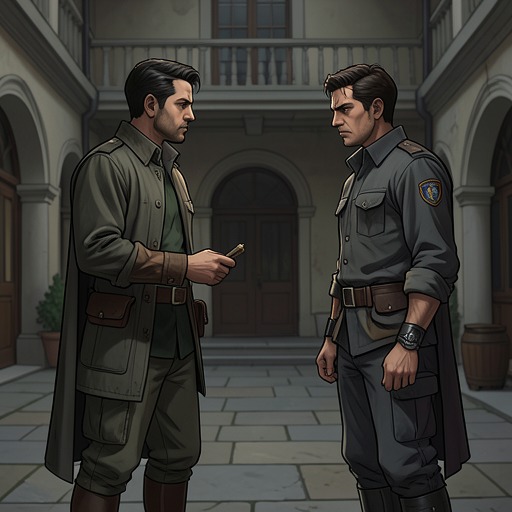
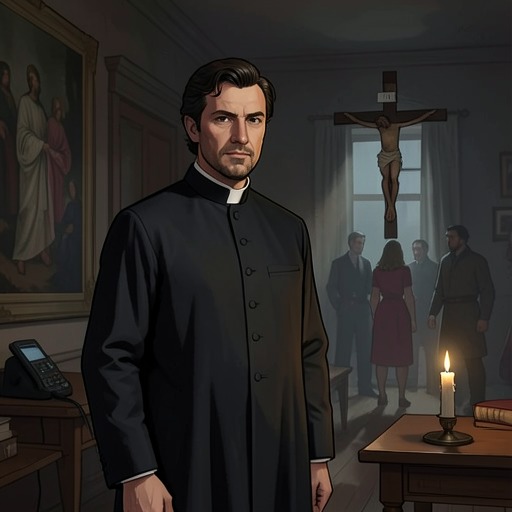
La piel del tambor“Absuélvame, porque he pecado” is the plea Lorenzo Quart addresses to Father Príamo Ferro after finding him detained at the police station. Kneeling before the unhandcuffed but visibly vulnerable priest, Quart makes a public gesture of respect and contrition; Ferro responds with the sign of the cross and the silent rite of absolution. The words mark a decisive shift in Quart’s role, from investigator standing apart from the church’s struggle to a man who acknowledges his own need for its consolation.
The phrase and its setting
The request comes at the end of a conflict shaped by church discipline, an old privilege, and the threatened demolition of Nuestra Señora de las Lágrimas. Lorenzo Quart had been sent to Seville to identify the author of a message and to maintain discreet contact with the local church authorities. The assignment placed him inside a dispute where ecclesiastical authority and practical control did not neatly coincide.
The Archbishop explained that the church’s demolition required its secularization, but an older privilege complicated that process. Granted in 1687, it stipulated that the church would retain its privileges while a Mass was said there each Thursday for the soul of its benefactor, Gaspar Bruner de Lebrija. The Thursday Mass was held at eight in the morning, on the day of Gaspar’s death in 1709. The condition made a recurring liturgy an obstacle to demolition, but not an automatic guarantee of the building’s safety.
Discipline, ritual, and the church’s precarious protection
The Archbishop framed the conflict with Ferro as one of discipline rather than authority: he could not simply prevent a parish priest from saying Mass. He had requested Ferro’s suspension ab officio from Rome, but the procedure was slow. The recent intrusion into the Vatican computer system further entangled the request with Quart’s mission, as the Archbishop expected the investigator to return with a report.
The Thursday service therefore carried both spiritual and legal weight. Macarena Bruner described how an envoy of the Archbishop and a notary paid by Pencho Gavira watched from the last pew, each alert for an irregularity or lapse. If Ferro, or another priest, failed to say the Mass or omitted its required formula, the church could lose the protection on which its survival depended. The ritual was not merely commemorative: its correct repetition held open a narrow defense against the wrecking ball.
Quart’s plea to Ferro
At the police station, Quart encounters Ferro in a small room guarded at the door. The priest has no cassock; his gray trousers show above old, unpolished shoes, and his white hair is roughly cropped. Although the police have chosen not to handcuff him, he appears small and exposed. Quart goes to him and kneels while the subcommissioner Simeón Navajo and the guard watch in astonishment.
Quart’s words—“Padre. Absuélvame, porque he pecado.”—are accompanied by the act they request: he waits motionless before Ferro rather than treating the priest as a suspect or a source of information. The narration presents the gesture as an expression of excuse, respect, and contrition, one Quart needs to make publicly. Ferro is first startled; then he raises a hand and makes the sign of the cross over Quart’s head. His eyes are wet with recognition, and he silently pronounces the old formula of consolation and hope.
Recognition and narrative significance
The scene reverses the expected posture of the investigation. The agent sent to assess the church’s crisis now kneels before the priest whose conduct has been at its center. No explanation or argument intervenes: Quart’s gesture and Ferro’s response enact a reconciliation through ritual, even as Ferro remains in police custody.
The surrounding imagery gives the encounter a further meaning. Quart’s inward figure of the lost soldier recognizes, across the battlefield, another brother still fighting. The image makes the absolution more than a private exchange: it joins two isolated men in a shared struggle, without promising that the struggle will be won. As Quart leaves the station, the ritual has offered recognition and consolation, not a resolution of the church’s institutional or material danger.